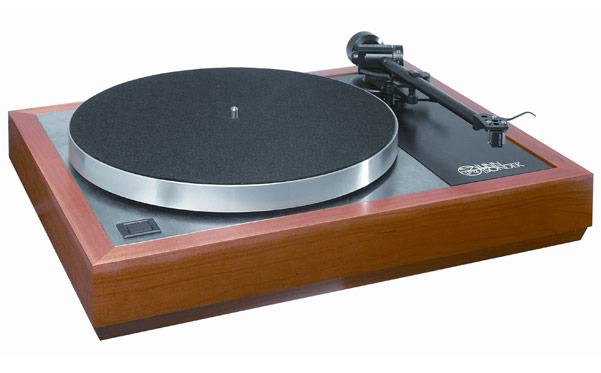
|
Welcome
|
|
|
There used to be a saying among the Scottish Hi-Fi community that the engineers coming out of university turned left to go to Heybrook and right to go to Linn. Despite the apocryphal nature of this anecdote, the truth is, the two designs share a number of things in common. They are both three point sprung suspensions as both are based on the original AR white paper for transcription turntables. They both use a wood plinth which looks similar, a two-piece platter, and identical dust covers (except for the logo--LP12 Vs TT2). The differences are in the details. The Heybrook TT2 has a massive sub-chassis compared to the Linn. It is very thick aluminium compared to the thin steel Linn use. The TT2 plinth is constructed of 1" thick MDF with a wood veneer, the LP12 of solid wood, usually English ash. In addition, most of the cavities inside the chassis of the TT2 are filled with shaped wood blocks, in the Linn they are not. The springs in the TT2 are stiffer and can be adjusted from the top plate using a 5mm Allen key. The springs of the Linn are adjusted from below by nuts. The top plate on the TT2 is much thicker than the Linn and black. The TT2 has a transport screw for locking down the suspension when shipping. The LP12 does not. The armboard in the TT2 is thicker but shorter while the LP12 arm board is the full front to back depth of the plinth. It is non-laminated like the older Linn armboards, but unlike the Linn, the Heybrook arm board is made of a plywood sandwich not MDF. Later models had different power supply arrangements. The TT2 bearing and platter are not so heavy as the Linn nor so finely machined. The oil is lighter weight than the Linn bearing oil. As far as sound quality goes, the TT2 is like a Linn. It has warmth and rhythmn and coloration. It is very comparable to an early Linn LP12 with Basik power supply. It lacks the refinement of the later Linns and the bass foundation of a better power supply, such as the Lingo or Armageddon. There used to be another saying that " Hamish Robertson who designed the Ariston RD11 was by nature a drinking man and not an entrepreneur. There came into his life a certain Ivor Tiefenbrun who suggested that his fathers' firm, from memory I think was called Castle Engineering, could machine parts for the Ariston turntable. Hamish accepted the offer and soon the product rolled of Ivor's production line. Imagine the shock some little time later when Ivor appeared at a northern Hi-Fi show with what seemed to be a carbon copy of the RD11 under his arm but now bearing the name Linn LP12. From the above, it would appear that at least the Ariston and the LP12 were designed by the same engineer, to whit, Hamish Robertson..!! Hamish, daunted by this, took to his bottle and some time later was found dead at home after a particularly heavy drinking bout. Rumour has it that he had committed suicide but I seem to remember the autopsy showed that he had asphyxiated by inhaling his own vomit. Ivor's reaction to this sad event is unfortunately not recorded and the demise of Hamish could not have come at a better time for him. Ivor went on to successfully exploit the design as Hi-Fi history will attest. The Ariston name passed to John Carrick and later emerged as Systemdek. I believe the marque has since been absorbed by one P. Quortrop of Audio Note fame." Product Introduction and Production Dates (dates and serial numbers are approximate) 1973 LP12 turntable introduced. [ 2,000] 1974 Main bearing liner changed. Sub-chassis strengthened by addition of strap, spot welded in place. Motor control circuit changed from terminal strip to small pcb. Mains switch changed from two buttons to single with mains neon. [23,000] 1978 Top plate modified adding two holes for 6x0.5 self tappers into wood block. <Linn claim Nirvana kit available this year> [27,000] 1979 Lid propr removed and hinges changed to spring loading. [32,826] 1981 February. Nirvana mechanical components. This consisted of : • 1 new spring kit (3 springs & 6 grommets), • 3 large locknuts, 6 small locknuts, • 5 black chassis bolts, • 2 motor mounting screws, domes, & nuts allowing it to be positioned with better accuracy. • 1 motor thrust bearing kit (endcap, spring, ball bearing). • 1 new drive belt. • The springs changed from zinc coloured to black. [38,794] 1982 May Valhalla crystal driven electronic power supply made standard. [53,000] 1984 Enlarged plinth corner bracing. [54,101] 1984 June. Sub-chassis strengthening bar epoxy glued instead of spot welded. [60,383] 1985 August. Cap head screws on bearing housing. [61,090] 1985 September. Diode modification to Valhalla. [n/a] 1985 December. Strengthening blocks on corners of plinth. 1986 Suspension springs improved. [n/a] 1986 May. New clear lid. [69,161] 1987 March New Formica and MDF armboard. [n/a] 1987 March New bearing housing. [69,591] 1987 April New springs. [70,000] 1987 Bearing improved with better lining material and tighter tolerances. Change to black oil. Suspension springs ground to improved tolerance. Arm board composition improved. [79,160] New MDF armboard, laminated top and bottom. [79,700] 1989 Motor thrust pad changed. Valhalla surge guard modification. PCB mains lead (UK). [81,000] 1989 Harder suspension grommets fitted. [n/a] 1990 Lingo power supply available as add-on. [87,047] 1991 Valhalla with 45. [87,047] motor thrust pad cap added to Lingo models. [87,206] motor thrust pad cap added to Valhalla models. [87,672] Introduction of LP12 Basik, Trampolin available. [87,672] Solid base board replaces hardboard. [88,950] 1992 Improved top plate fixing. [90,582] 1993 Cirkus upgrade fitted as standard. [n/a] 2002 Adikt moving magnet cartridge introduced. Maple plinth introduced adding to existing black, cherry, walnut, rosenut and afromasa options. A document with content similar to that given above, detailing the LP12's upgrade path is available here (3kB). arm - this is not strictly part of the LP12 as a variety of arms can be fitted to it. The function of the arm is to hold the cartridge above the record. The quality of the arm affects how vibrations are transmitted to and from the cartridge and has considerable effect on the sound. arm board - this is the part to which the arm is attached and fixes the arm to the sub chassis. It also supports the arm rest if the arm rest is not already part of the arm and completes the turntables top surface filling the gap between the top plate and the plinth. bearing - the bearing supports the platter both vertically and horizontally and connects the platter's spindle with the sub chassis. The bearing must support the platter and allow the platter to rotate freely with little friction. It must support the sides of the spindle tightly enough to couple the spindle to the sub-chassis but smoothly enough so it does not generate any noise. motor assembly - The motor drives the inner platter via a belt. The motor used is the same design as used in the original LP12. Originally made by Philips subsidiary Impex the company was later sold to Airpax. List members have measured the motors resistance at 8.8Kohms and inductance at 10H. platter - the platter is the part that spins and supports the record. The LP12 has a two part platter. The inner platter has a spindle which locates in the bearing and is the part that is driven by the belt from the motor. The outer platter fits on top of the outer circumference of the inner platter extending its top area to the size of a 12inch record and providing the rotational inertia. "The platter takes a month to produce, as it is turned, then put away, then turned, and put away, and on and on, till the machining is complete. This is because they want the metal to remain UNSTRESSED, so as to avoid a severe resonant peak in the metal's structure, due to overheating. Replace the undamped platter on the inner platter, and give it a tap, and you will see how fast the noise dies down, without a long decay period." plinth - this is the wooden bit that forms the frame of the turntable. It has a series of square section channels routed along the sides and front giving the LP12 its distinctive look. power supply - The power switch is the best way of determining which PSU an LP12 is fitted with. The Nirvana supply has a large square illuminating switch. The Valhalla has a black square with a small red LED in the middle. The Lingo has a black square switch with one small red LED and one small green LED. The Lingo is also enclosed in an external box rather than being situated within the plinth itself. springs - the turntable has three springs which support the sub chassis at their top and are supported by bolts at the bottom which run back up through the center of the spring, through holes in the sub-chassis and are attached to the top plate. top plate - this is a steel plate the forms the top surface of the turntable. It has holes in it through which the bearing and motor assembly protrude. It forms the fixing points for the suspension bolts. The top plate is deliberately made slightly oversize for the plinth and when it is fitted it bows down slightly near the arm board. This is done to minimise vibration. The LP12 began as a single model but was later improved with more sophisticated motor power supplies. This later became formalised with three versions of the LP12 available LP12 Basik Description: The LP12 Basik was introduced in 1991 as
an entry level LP12. A 25 page setup manual for the Linn Sondek LP12 is availalble here (without diagrams 64k) or here (with diagrams 723kB). LP12/Valhalla Date of introduction: 1984 LP12 Lingo Date of introduction: 1990 One area of variation of LP12s is the motor's power supply (as is obvious from the section above). It is claimed that the power supply makes a large difference to the sound of the turntable. Linn have brought out a number of power supply variations as have a number of third party vendors. These are listed below. Linn supplies Axis Description: The power supply from Linn's Axis turntable. "Basically a Valhalla with a 45 rpm option and can be fitted to a LP12" Basik Description: A basic resistor / capacitor network
designed to provide voltages with the required magnitude and phase to
run the motor. Lingo Description:The Lingo drives the LP12 motor with two
low distortion sinewaves separated by 90 degreees from two high voltage
amplifiers. The sinewaves are derived from a low noise crystal oscilator.
A unique circuit monitors the motor and during start up drives the motor
hard but when 'lock' is achieved the power is reduced to a level at
which the motor runs almost silently. "Using the Valhalla, the presentation is nice - it has a full atmospheric bass quality. Changing to the Lingo improves the sound quality in every area by a big margin, BUT it changes the presentation so that it is much leaner in the bottom end." "When I moved from Valhalla to Lingo I was stunned by the magnitude of the change. The apparent dynamic performance was markedly better, blacker blacks between notes, more communication of emotion, everything just pounded along. Far less watery modulation of piano etc. You know then that the PSU is of major importance." Valhalla Description: The Valhalla is a synthesized AC source,
the board rectifies the AC line, then uses a cheep and cheerful crystal
oscillator and other circuitry that is used to create a single sine wave
at 50Hz, then a simple phase shift cap is used to provide the shift for
the second winding. Other supplies Avondale PSU Description: 'Transformer in a box' style supply. The
Avondale power supply is a unit that conditions the mains supply while
reducing its level so it is suitable for supplying to the motor. The
output level is variable. "The Avondale power supply contains a circuit which is difficult to see the details of. However from the mains input it appears to run through a fuse and through some conditioning circuitry as there appears to be a varistor as well as some resistors and capacitors which would clean up any voltage spikes. There is then an on/off switch and led indicator. The supply then goes to the first of two transformers. After this there is a pair of circuits comprising power resistor, diodes and capacitors forming a resonant circuit before a second transformer. After this another power resistor, capacitor, diode arrangement feeds a stepped attenuator and from there the output socket" Heybrook TT2 <insert details when available> HiFi News & Record Review / Moth FlutterBuster Description: Runs with most sychronous (AC) TTs, providing 33 and 45 rpm output frequencies. "Sound quality won't be quite as good as a Lingo." Date of introduction: Currently discontinued. HiFi News & Record Review / Pure Cycle Description: Provides AC power of very high purity
with low noise, low distortion and high frequency stability, with low
jitter. Switchable frequency change provides 33/45rpm. Manticore MB5i Description: External electronic power supply for AC synchronous motors. A crystal controlled clock is divided down to give 50 and 67.5Hz square waves. These are converted into pure sine waves using op-amp filters. The 90 degree phase shift which is optimum for AC synchronous motors is obtained using a phasing capacitor. The signals are then amplified by high voltage bridge amplifiers. Date of introduction: From MAV Shareholders Ltd. Our supplies produce a perfect 90 degree lag on two separately controlled and stepped square waves and process them into perfect sine waves, finally amplifying them discretely and completely separately. We then get the benefit of pure stiff control of each motor winding." Manticore MB6 Description: External electronic power supply for AC
synchronous motors. A crystal controlled clock is divided down to give
50 and 67.5Hz square waves with 90 degree phase shift. These signals are
converted into pure sine waves using op-amp filters. They are then
amplified by high voltage bridge amplifiers. "The Manticore MB6 which can also be used on LP12s. The only thing I can say is that it was a large improvement over the normal resistor + capacitor network. The designer Doug Hewett claims that it is better than the Lingo." Manticore MB6i Description:The MB6i has the digital phase shift and
two separate amps for the sine and the cosine signal. MAV Shareholders Ltd, The Old Tinsmiths, Shortmead St, Biggleswade, Beds, SG18 0AP. (+44) 1767 318 437 fax (+44) 1767 318 462. Naim Armageddon Features: 'transformer in a box' style supply. No 45
rpm option. "Now, moving to the Armageddon [from a Lingo] I notice: Naim Audio Ltd., Southampton Road, Salisbury, England SP1 2LN (+44) 1722 332266 Norton AirPower Description: 'Transformer in a box' style supply
similar to the Armageddon but cheaper (as a customer install product,
not so much cheaper when it was sold through dealers). The unique
feature is that it uses dual secondary transformer windings to tailor
the voltage instead of drop-down resistors. It seemed a decent step forwards from my off-board Valhalla. I also wanted a pure sound which did not show treble nasties and achieved that. It is VERY heavy as I believe it has a 1KVA transformer. It seems very well built and has not given any problems in 3+ years. Tel +44 (0)1245 601596, see www.norton-tech.co.uk (2003) Origin Live Description:"This high grade motor kit is designed
as a drop in replacement for almost all turntable motors and has greatly
benefited most leading turntables such as Linn Lingo, Roksan, Pink
Triangle, Rega, Thorens, VPI, Michell, Heybrook, Opus, Oracle, Well
Tempered, Acoustic Research, and Systemdek to name but a few." Pink Triangle Pink Linnk ("Plink") Description:"The Pink Linnk PSU is a DC battery
based PSU. Pink Triangle install a new top-plate with a AC motor. The
PSU provides 33 and 45 speed selection. The top plate was black rather
than silver and had the motor positioned at around 'half-past-seven'
rather than 'ten-o'clock'. It had a Valhalla style single-LED switch.
The sesign is based on the Pacesetter suppy for the PT TOO" "I *believe* the AC motor version of the Plink added a small amount of 3rd harmonic distortion to the voltage waveform in order to even out rotational non-linearities in the motor. This should lead to more accurate rotation and less motor vibration. As far as I know this is a unique feature of the Plink, but it may be present in other PT AC supplies." Linn Arms Akito, Akito II Description: Entry level arm. "The Akito does not happen to be lucky with moving coil cartridges. The Akito II may fare a bit better, but then it should, as it costs a lot more than the old version." "The Akito is as good as the early Ittok arms." Ittok LVII, LVIII & LVIII/2 Description: Top of the range arm. Later superseded by
the Ekos. A set up manual for the Ittok LV-II is available here. The Ittok came first as LVII, later replaced by LVIII and finally (for a short period) as LVIII/2 with Ekos-type arm-rest (no hole in the arm board needed). The Ittok LVII has a mark 1 and mark 2 series. The mark 1 has a two piece counter weight, a smaller diameter pillar, and a 5 mm set screw in the arm collar to name a few features which make it easy to distinguish from a later mark 2. "The final version was as good as the early Ekos arms!" The LVII also existed in black. They were more expensive as new and are very rare. Only 1000 were made. There were also a few black LVIIIs. Ekos Description: Top of the range arm. "The Ekos exists in two generations but the arm wasn't renamed. Ekos II came around 1992, Ekos with serial numbers above 6490 should be IIs. The improvement is changed bearings and the difference is IMO significant. I don't know of any improvements since. Linn offered rebuilding to the new bearings." LVV Description: Introductory level arm. LVX Description: Budget arm. Improved version of the LVV. LVX Plus (Basik Plus) Description: Improved version of LVX with fixed
headshell and more substantial bearing. Other Arms AudioQuest PT Description: "I've been told the AudioQuest PT arms work well on the LP12 and are easy to mount." Graham 1.5 Description: "Graham has a new mounting system that they're offering in addition to the SME style mount. It's a round cut-out, with three screws. They'll supposedly be offering this with dedicated armboards for a number of tables (Linn, VPI, and Basis, I believe). They're not recommending the new 2.0 arm for the Linn, due to its increased weight. So, it looks like the the Graham for Linn arm is a 1.5 with brass side weights, using the new mount and a Linn style armboard." Naim Aro Description: A unipivot arm i.e. when in use the arm
is supported at the stylus and another single point. "a softer and sweeter balance than comparable gimbal bearing arms" "Although the Aro looks flimsy, it sounds excellent. I would recommend the Aro or the Ekos - they both sound different but better than an Ittok. The Aro has very fine treble detailing and a very open sound." Rega RB250 Description: For those on a budget, the RB250 will offer astonishing performance for its price. It is fitted as standard to the famous P2 turntable and is also the choice of many other turntable manufacturers on an OEM basis. Date of introduction: Rega RB300 Description: The RB300 has a more sophisticated vertical bearing assembly, a stainless steel rather than brass pillar assembly, a stainless steel counterweight shaft, and either a tungsten or stainless steel counterweight (there are now two versions). It also has a reverse spring loaded tracking weight adjustment. Date of introduction: "Contrary to many views the Rega RB300 (new one) *can* be fitted and sounds excellent." "the RB-300 easily can sport multi-$ cartridges" "Some people think that the RB250 is better, and in many installations there is not much difference between the two. The original Rega tonearm sourced from Acos in Japan, I believe, was more musical in my opinion than the newer ones and there are a lot out there so this a tip for impoverished addicts as they will cost very little to get hold of." "Here's another suggestion. The tracking weight on the RB300 is designed via a reverse spring assembly. That is to say that set at 0 grams, the spring is fully tensioned, and at 3 grams or whatever the upper limit is, it is not tensioned. Try playing the arm with the setting at the upper limit (i.e. not tensioned) and the tracking force set purely by the counterweight position." "The tracking weight on the RB300 is designed via a reverse spring assembly. That is to say that set at 0 grams, the spring is fully tensioned, and at 3 grams or whatever the upper limit is, it is not tensioned. Try playing the arm with the setting at the upper limit ( ie not tensioned ) and the tracking force set purely by the counterweight position." "Rega arms are exceptionally well made and are a bargain at the price. They are also a very safe bet to buy second-hand. The weak point on the tonearm (allegedly) is the wiring. The arms are earthed by a small clip that locates on the inside thread that takes the counterweight shaft. This clip has a wire that attaches to the left hand signal return ( blue ) on the small PCB that joins the internal loom to the ( attached ) output cable at the base of the tonearm pillar. The output cable is a single hot with screen and so the signal return on each channel is superimposed on the screen, and even worse, the left hand channel is superimposed with the tonearm earth. And finally, the wires that you see coming out by the headshell ARE NOT the internal loom. The latter is soldered onto those wires as part of the little rubber assembly that blocks the armtube. The good news is that rewiring the arm (properly) makes massive improvements and this is a great credit to the mechanical design. And don't forget, if the arm was wired to a higher standard, the price would increase, and less people would have access to what is still a very fine product." Rega RB600 Description: The RB600 is a high performance version of the legendary RB300 tonearm. The RB600 is lovingly constructed to extremely high tolerances by a dedicated team of production technicians. To further improve musical detail the RB600 carries an extremely high performance Rega designed phono cable assembly with state of the art Neutrik connectors. Date of introduction: Rega RB900 Description: With precision blueprint engineering assembly and dedicated "zero" tolerance tripod mount bearing assemblies this tonearm takes the RB300 tonearm design to a very high performance level. Date of introduction: A description comparing to the RB300 "Grey instead of Black. The cable is thicker and black and "more expensive" looking, The RCA connectors, have a sort of push in/out collar. The connectors and the cables looks of higher quality than the RB300. It is mounted by using three screws and the base has three mounting "arms" or "feet" positioned 120 degrees apart". In comparison with RB300 and Roksan Tabriz Zi tone arms: "LPs sound less distorted. Produces a more sure, confident sound. More transparent, but not by the enhancement of high-frequency detail, but from the midrange down transparency. I can't tell if there is the same, more, or less extension to the base or whether it is the same, tighter, or warmer. A bit of bass heaviness." Features: No VTA adjustment other than the use of spacers. Rega RB1000 Description: The RB1000 carries more technological changes over previous Rega tonearms than any other Rega tonearm produced during the last twenty years. Key areas of improvement can be found in the bearing assemblies, wiring and materials used. We have worked to redistribute and reduce mass in areas of the tonearm where mass is critical to performance - the polished aluminium arm tube has no coatings of any type. The changes made over the RB900 have resulted in a tonearm with extremely high structural rigidity, combining ultra low friction movement together with incredible stability. Date of introduction: Zeta Description: A contemporary of the Ittok made by "a
London garage company". However it suffered with quality control
problems especially with the bearing adjustment. "When adjusted well, it outperforms an Ekos arm. It has the same bass dynamics and imaging, but very smooth and lush midrange and treble in contrast to an Ekos 1 with a very detailed, analytical midrange or the Ekos 2 with its lack of treble." What is the correct arm board cut out and geometry for my arm? It depends on the arm. Some are listed below. Akito Ekos Ittok Rega RB300 The distance from the centre of the spindle to the
centre of the mounting hole is 8.76 inches. The mounting hole is 23mm
diameter. Which arms have the same cutouts? Graham ---> SME I don't have one of the arms listed above - what should I do? Luckily one of the list members Rex, has produced a table. Look up the length of your arm (arm pivot point to stylus diamond) in the table to get the best geometry. Alternately if you already have an arm fitted measure the arm pivot to platter centre distance and use the first column to determine the arm length. To paraphrase the results below the two points are 72 and 116 mm. "The following is intended as a guide to those setting up arms on turntables. The numbers are generated using a non-linear function optimisation algorithm. The column marked Dst is a relative indication of the error caused by the geometry (objective function), and the columns marked Null are the two points from the centre of the platter at which the stylus is tangential. The easiest way I have found to set up a turntable is to get the effective arm length correct (that is pivot to diamond), then twist the cartridge in the headshell so that the stylus lines up correctly on a protractor at the two null distances (fortunately always around the same number). Note that the Overhang column is not projected into the vertical plane parallel with the cantilever." Platter to arm pivot | Arm length | Offset | Dst | Overhang | Null | Null (mm) | (mm) | (deg) | | (mm) | (mm) | (mm) ----------+------------+--------+-----+----------+------+----- 210.0 | 229.0 | 24.2 |1.094| 19.0 | 73.1 |115.8 211.0 | 230.0 | 24.1 |1.090| 19.0 | 73.1 |115.8 212.0 | 230.9 | 24.0 |1.085| 18.9 | 73.1 |115.8 213.0 | 231.8 | 23.9 |1.080| 18.8 | 72.4 |115.8 214.0 | 232.8 | 23.8 |1.074| 18.8 | 73.1 |115.8 215.0 | 233.7 | 23.7 |1.069| 18.7 | 73.1 |115.8 216.0 | 234.6 | 23.6 |1.065| 18.6 | 72.4 |115.8 217.0 | 235.5 | 23.5 |1.060| 18.5 | 73.1 |115.8 218.0 | 236.4 | 23.4 |1.055| 18.4 | 72.4 |116.4 219.0 | 237.4 | 23.3 |1.050| 18.4 | 73.1 |115.8 220.0 | 238.3 | 23.3 |1.045| 18.3 | 73.1 |116.4 221.0 | 239.2 | 23.2 |1.041| 18.2 | 73.1 |116.4 222.0 | 240.1 | 23.0 |1.035| 18.1 | 73.1 |115.8 223.0 | 241.0 | 22.9 |1.029| 18.0 | 73.1 |115.8 224.0 | 242.0 | 22.9 |1.026| 18.0 | 72.4 |115.8 225.0 | 242.9 | 22.8 |1.022| 17.9 | 73.1 |116.4 226.0 | 243.8 | 22.7 |1.017| 17.8 | 73.1 |115.8 227.0 | 244.7 | 22.6 |1.012| 17.7 | 72.4 |115.8 228.0 | 245.7 | 22.5 |1.008| 17.7 | 72.4 |115.8 229.0 | 246.6 | 22.4 |1.002| 17.6 | 72.4 |115.8 230.0 | 247.6 | 22.3 |0.999| 17.6 | 73.1 |115.8 231.0 | 248.5 | 22.3 |0.995| 17.5 | 73.1 |116.4 232.0 | 249.4 | 22.1 |0.989| 17.4 | 73.1 |115.8 233.0 | 250.3 | 22.0 |0.984| 17.3 | 72.4 |115.8 234.0 | 251.3 | 22.0 |0.981| 17.3 | 72.4 |115.8 235.0 | 252.2 | 21.9 |0.977| 17.2 | 73.1 |115.8 236.0 | 253.1 | 21.8 |0.973| 17.1 | 72.4 |115.8 237.0 | 254.1 | 21.7 |0.969| 17.1 | 73.1 |116.4 238.0 | 255.0 | 21.6 |0.965| 17.0 | 72.4 |115.8 239.0 | 255.9 | 21.5 |0.960| 16.9 | 73.1 |115.8 240.0 | 256.9 | 21.5 |0.957| 16.9 | 73.1 |116.4 241.0 | 257.8 | 21.4 |0.952| 16.8 | 73.1 |115.8 242.0 | 258.7 | 21.3 |0.949| 16.7 | 73.1 |115.8 243.0 | 259.7 | 21.2 |0.945| 16.7 | 73.1 |116.4 244.0 | 260.6 | 21.2 |0.941| 16.6 | 72.4 |115.8 245.0 | 261.6 | 21.1 |0.937| 16.6 | 72.4 |116.4 246.0 | 262.5 | 21.0 |0.933| 16.5 | 73.1 |115.8 247.0 | 263.4 | 20.9 |0.930| 16.4 | 72.4 |116.4 248.0 | 264.3 | 20.8 |0.925| 16.3 | 73.1 |115.8 249.0 | 265.3 | 20.8 |0.922| 16.3 | 72.4 |115.8 250.0 | 266.2 | 20.7 |0.918| 16.2 | 73.1 |116.4 I have heard rumours that the bearings in some tonearms disintegrate due to the vibrations from a moving coil cartridge. Is this true? No. "Many moving coil cartridges (MCs) tend to have lower compliance figures than moving magnet cartridges (MMs), and a few MCs are deliberately designed to dump a lot of mechanical energy into the tonearm. But even something like the Deccas will put a lot of energy into the tonearm, and these are certainly not MCs. In any case, if the tonearm suffers from loose bearings or bearing rattle, the tonearm will not be able to control the mechanical energy from the cartridge properly, and the result will sonically not be as good as it would be in a tonearm with a better bearing system." Note that the above is NOT the same thing as disintegrating bearings. Unless the bearings were cracked to begin with, the tonearm should remain in good health regardless of the type of cartridge used). However, it IS possible to create a flat spot on a bearing through user abuse. This usually occurs when the user (most likely while installing or adjusting a cartridge) puts too much stress on a gimballed-bearing tonearm which has bearing tolerances that are very close or a little on the tight side and bearings that are not as mechanically hard as they should be. The factors determining the susceptibility of gimballed bearings to loose bearings or bearing rattle is the bearing precision, hardness and wear. In unipivots the main factor is the amount of pressure (usually the force of gravity) applied to the bearing, but in most unipivot tonearms, loose bearings or bearing rattle will not exist. Tonearms which are immune to loose bearings or bearing rattle because of their fundamental design include the Naim ARO, the Morch UP series, the Ultracrafts/Audiocrafts, the Wilson-Benesch and the Graham. I suppose that there are others as well, including the Well-Tempereds, probably the Roxans, and many others that I simply don't know about. Gimballed arms like the Linns, SMEs, Regas etc. can and do have excellent bearing performance, but for top performance, the bearings do tend to demand a higher degree of execution than a unipivot. A final note - be wary of tonearms with excessive bearing friction, or tonearms with no anti-skating (which I believe unfortunately includes the new VPI JPW Memorial tonearm), as these can and will gradually damage your records and the cartridge suspension. As I may have mentioned in a previous posting, tonearms with undamped lift mechanisms are also a no-no for many precision cartridges." How can I check an arm for bearing damage? NOTE: It is very important that you use utmost care in conducting these tests to prevent the arm from flying away and damaging itself. It is advisable to carry them out with your cartridge's stylus guard in place. "One method you might use is to balance your arm so that the cartridge floats above the records surface with zero tracking force and zero anti-skating force. Then gently nudge it in either direction (using your other hand to prevent it from going too far) and observe how it reacts to horizontal movement. Then go ahead and apply some anti-skating force and see if the arm moves outward from the inner grooves. It should move outward with just a very slight amount of anti-skating force applied if the horizontal bearing is working properly. You can also assess the operability of the anti-skating mechanism during this test, as well. Perhaps it is applying too much force outward. Additionally, you should check the vertical bearings by placing a small piece of paper (one square centimetre) on the headshell and observing that the arm moves downward slightly. If it does not, try a couple of pieces of paper, but if it takes any more than two, this may indicate excessive friction in the vertical bearings. A properly functioning arm will exhibit extremely low friction in all directions." Most cartridges can be fitted to a LP12 although this also depends on the arm fitted. However some cartridges are more popular on LP12s than others. Linn also produced their own cartridges. This section has details about the Linn cartridges and others popular on LP12s. Linn Cartridges Adikt Description: A moving magnet cartridge to replace the discontinued K9. Anuminium cantilever, copper coil, replaceable Gtger II stylus. Date of introduction: 2002 Akiva Description: A moving coil cartridge designed to replace the Arkiv B. "The magnetic structure ... caused all manner of mechanical resonances... the single large one (magnet) was replaced by two migets which could be held in front of the coil assembly" "the moving pars.. are the same (coil, diamond, cantilever and so on) in the Akiva as in the Arkiv (B)" Date of introduction: Arkiv Description: A moving coil cartridge designed to retrieve the most musical information from the groove and maximise record life.. Top of the range model replacing the Troika but said to be "a very substantial improvement over it". This is the only cartridge that Scan-Tech designed and builds for Linn. "Among the other cartridges that Scan-Tech have done, probably the most similar ones in concept (if not in execution) to the Arkiv are the Spectral MCR family and our own Lydian." "The Arkiv uses a system in which the magnet and generator assembly are bolted directly to a skeletal aluminium block that serves as both chassis and exterior housing. As it does not have a plastic sub-chassis, the Arkiv's generator system suffers from less resonance and less monkey movement than the Troika (although I wouldn't be surprised if the resonance and monkey motion are exactly the things that endear the Troika to its proponents). The clear plastic piece on the front of the Arkiv is a non-structural element designed primarily to protect the internal components of the cartridge." Date of introduction: 1992 Asak Mk 2 The Mark 2 Asaka has higher output, improved stylus profile and better tracking than the original. Date of introduction: 1997 Asak Description: A moving coil cartridge, top of the range in the early 80s. Plastic body. Date of introduction: 1985 Asak T Description: moving coil. An Asak but put together better. Date of introduction: Asaka Description: A moving coil cartridge, a successor to the Asak. It has an aluminium body and a better fitting cover than the Asak which has a metal cover that is quite easy to remove. Date of introduction: Basik Description: moving magnet. Initially a 'freebe' cartridge given away with LVV and LVX arms. Later improved in the yellow bodied version. Date of introduction: . Yellow Basik 1983. K5 Description: entry level moving magnet. Date of introduction: 1988 - 1996 K9 Description: A robust moving magnet cartridge for good information retrieval. Made by Audio Tech. Date of introduction: 1986 - 1996 K18 Description: moving magnet Date of introduction: 1988 - 1996 K18/II Description: moving magnet Date of introduction: 1992 Karma Description: low output moving coil. Superseded Asak as top of the range. Looks like Asak and has aluminium cantilever. Unlike the Asak it has a solid aluminium body, more powerful magnet and different pole piece geometry. As opposed to previous Supex cartridges badged as Linn this was the first designed by Linn and manufactured by Supex. The Karma is clearly much more of a Linn cartridge than its predecessors. Date of introduction: 1983 "Downforce of 1.7g, which gave adequate tracking
abilities but left little in hand." Klyde Description: moving coil. Replacement for the Asaka but described as "of virtual Troika quality". The Klyde is made by Goldring (to Linn specs) although it is claimed the housings are manufactured by SME. Date of introduction: 1992 Troika Description: Top of the range cartridge when introduced. It has a red housing which is machined from high tensile alloy and a three point mounting that only fits the Ittok and Ekos arms. It has flying leads rather than the usual pins for connecting to the arm. A development of the Karma cartridge. Manufactured by Supex, the two were manufactured side by side for a time. "The Troika can be considered to be a variant of the old Karma design. In both of these older cartridges, the magnet and generator assembly was mounted to a plastic sub-chassis, which was in turn bolted to the aluminium outer housing (which was a "U"-shaped extrusion that wrapped around the cartridge internals. The cartridge was capped with a thin, aluminium L-shaped plate that protected the delicate internals." Date of introduction: 1986 "I track a Troika at 1.6 - 1.7 grams. Higher than this
and I get a thick, ploddy sort of emphasis. Less than this and I start
to hear mistracking and lack of adequate "orchestral scale"." Will I set the turntable up myself "out of the box"? "If anybody is considering this, I don't recommend it. Upon opening the box, the first thing you notice is a startling lack of directions. The owners manual says that there is no information contained therein pertaining to setup, which they leave to the dealer, and they are not kidding! All you get is a diagram of the underside of the table. It turns out that the diagram is indespensible if your are going to go it alone." "I had no trouble hooking up the Vallhalla, as its relatively self explanatory. You clip it into place underneath and hook up the wires. Then you bolt the cables down where necessary." "Next I bolted the arm base to the armboard. This threw me. The arm height locking screw would point towards platter if the "Ittock" emblem faced the front. Well, that is no good, as then you could not get the to the screw without removing the platter. So, I turned the collar round 180 degress so the screw was accessable from the right hand side of the table. This way the emblem points towards the rear of the table." "You have to get the tension of the arm base bolts right, the crimps (washers between the bolts and the arm board) have to sink in a little way as the get a good grip but without breaking anything." "In my sample, the hole in the arm board for the arm support was not drilled all the way through the armboard. So with collar attached but without arm support attached, I screwed armboard to sprung chassis." "I raised the turntable to allowed easy access to the bottom of the table. I lifted off the bearing plug, removed a plastic sleve from the spindle and put the inner platter into the bearing and it slid in nicely. I noticed that the bearing is not built to the same tolerance as the Rega or VPI bearings, which create all kinds of positive and negative airpressures when trying to put in and remove the spindle. The Linn bearing just kinda falls into place and is removed without creating much of a vacuum." "What you have to do is place the arm lead in steam, say over a kettle [taking care not to scald yourself], and then run your fingers down the lead to make it become nice a straight. When it cools it will stay like this. It is very important to get the arm lead tension correct, to tight and you will get vibration fed-in, too loose and the suspension will twist and turn, both mistakes will give you poor bass control, this is what many anti-Sondek people have heard. A way to test this is to bounce the platter up and down, the arm board should not twist and their should only be a up and down movement with a nice slow decay, in other words it should not wobble around like a jelly. By the way you need to tighten the arm bolt (the one with the bolt on the right of the arm) as tight as you can, do not worry if it creeks a little." "Then I put on the belt and put the platter on. I put on the mat and a record also. I adjusted the suspension so the armboard ran a little higher (say 3-4 mm) than the base. I connected the arm cable to the base of the arm with a cable tie, making sure it did not touch anything else and ran it out the back of the table." "When the belt is correctly aligned the startup will cause the belt to move down on the pulley where when it gets up to speed it will move upwards about half way. There should be a slight tilt in the motor so the spindle is pointing towards the outside of the turntable." "If the belt is rubbing against the upper portion of the belt guide lower the far side of the motor by screwing in the adjustment screw." "The baseboard cover is not pre-drilled so you to do that too." How should I ground the arm? The standard arm cable has two pairs of signal leads and a ground lead. The ground lead connects the pre-amp at one end and the arm connector at the other. The ground lead should also be split out to connect <insert details here> The screw nearest the arm connecting the arm board to the sub-chassis and also to the bolt nearest the front of the turntable that holds the metal cross member that holds the power supply and the p clip. How do I "dress" the arm cable? The cable carrying the signals from the base of the arm to the pre-amp forms part of the turntables suspension, getting the correct position and correctly fixing the arm cable allows the turntable to operate at its best. Before exiting the plinth of the turntable the cable is secured by a p clip. Two points are important here : 1) the cable does not and can not touch any part of the turntable between its leaving the arm and the p clip. However it must also be slack enough not to pull the suspension horizontally and must allow it to freely move vertically. 2) the cable should be securely held by the p clip - if you pull the arm cable it should not slip through the p clip. To achieve this get some leverage on the p clip, pulling it tight on the cable while securing it with the nuts. After being secured by the p clip the cable should loop up towards the top plate and then down and sideways to the back of the turntable where it exits via a notch at the bottom of the plinth. How should the spindle be lubricated? The spindle should be clean when inserted into the bearing and is lubricted by the oil in the bearing. Any excess oil in the bearing is pushed out as the spindle slides down the bearing. "If you have got the right amount of oil in you should be able to lower it very slowly into the spindle, mine use to take a few hours to completely settle down." Preface "One particular potent bit of Linn folklore attaches to the adjustment of the LP12 springs. The legend tells us that the true transcendental LP12 sound only springs forth when the suspension springs have been perfectly adjusted, and that only the best of the best technician priests really know how to do this. Actually the spring adjustment procedure is quite simple. The correct configuration is not that hard to obtain, and not that hard to recognise. Basically, you are trying to get the armboard and platter assembly level with the plinth, centered, and free to move in all directions. To test the suspension, you tap it vertically near the centre of gravity. If a vertical tap causes a smooth vertical oscillation of the entire platter - armboard assembly you are done. If the tap causes irregular motion (the vertical oscillation produces horizontal or rotational modes), then the springs need to be adjusted." on the other hand "Setting up a Linn Sondek should not be under estimated by any means, my Linn dealer took over two hours to set mine up from out of the box and this was as fast as he could go with all the Linn setup tools. There is a Linn course in Scotland which lasted for about three days on turntable setup. The Sondek is the most fussy turntable I know of, if it isn't setup correctly and many are not - it will not sing." Theory The design of the turntable attempts to isolate its parts into two. One part is connected to the real world, the other part is disconnected in an attempt to isolate it so it is unaffected by its environment. The isolated part comprises the sub chassis, bearing, sub-platter, platter, vinyl, cartridge, arm and arm board. The sub chassis is supported from underneath by three springs which are themselves supported by washers which hang on the ends of three bolts attached below the top plate. Thus the isolated part can be affected in three ways, via the springs, via the belt or via the air surrounding it. As the springs support the weight of the platter the set-up of these has the greatest affect on the turntable's sound. The LP12 is notorious for being sensitive to how it is set up and once set up physically moving the turntable or the passage of time is likely to degrade the setup. Static setup In normal operation the turntable should be placed on a level support. To ensure levelness of the support some means of adjusting the levelness is usually necessary. It is therefore a good idea to set up the suspension with the turntable in its usual operating position and begin the setup by levelling the support. Access to the inside of the turntable is necessary during setup and this is gained by removing the base plate. Access is made easier if the turntable is raised in some way, four full drink cans, one at each corner are a convenient means. If the support is level the top of the plinth should also be level. Place the mat on the platter, and an average weight and thickness record on the mat. Use a record that has no value to you (in case its gets damaged). The sub-chassis sits on top of three springs which are held at their bottom by three bolts which then run up the centre of the string to the top plate. Misalignment of this assembly is the commonest source of problems. The top rubber grommets should be centred round the bolt and the sub-chassis should be properly seated on the grommets. To adjust the height and levelness of the sub-chassis, arm board and platter the nuts at the bottom of the suspension bolts are rotated either to raise or lower it. By adjusting the nuts on the suspension bolts by differing amounts the suspension can be levelled. The height should be adjusted so that the arm board is brought level with the plinth and the platter level with the top plate with a gap of about 2-3mm equally all round. Check with a spirit level on the platter. Since the turntable support has been levelled, levelling the platter should result in an equal distance between the platter and the top plate all round. If you notice that the top plate is slightly warped in a downward fashion along the edge adjacent to the armboard, this is normal. The top plate is stressed when fitted into the wooden plinth, for better resonance control, and transmission of unwanted energy. You are now ready to set up the suspension. Rotating the springs affects the horizontal position of the sub-chassis and arm board. The position should be adjusted to centre the arm board in its position within the plinth by rotating the springs. If you have trouble setting up the suspension it may be because the springs are old. The weight supported by each is unequal, the spring nearest the arm has more to support. With time the compression rate of the spring changes upsetting the bounce of the suspension. Consider swapping the most stressed spring with the spring nearest the motor assembly which is the least stressed. Dynamic setup The dynamic setup of the suspension is tested by bouncing the suspension and observing how they die away. The suspension is set bouncing by pushing down on the platter at the sub-chassis centre of gravity. This point is near the intersection of a line between the spindle and arm pivot and the outside of the inner platter. When excited the suspension should oscillate in a vertical direction only with no horizontal or erratic motions. If there is any tendency for the sub-chassis to move horizontally this should be adjusted out by rotating the springs and their grommets. This works because the springs are not completely symmetrical and have a soft and a hard side. The idea is to have the springs balance each other out. Begin with the spring and grommet on the left of the turntable. Rotate both by 1/8th of a turn until the bounce is a straight as possible. Be sure to rotate both as otherwise you may introduce a twist in the spring which will upset the suspension. Rotating the springs may change the height of the suspension so before adjusting the next spring check the suspension is still level and adjust if necessary. Next adjust the front spring & grommet in the same way and then the rear spring & grommet. When all three springs have been rotated, untwisted and levelled the suspension's bounce may still not be correct and the process may have to be repeated a few times. When complete check there is no twist in the springs, that the suspension can move in all directions without the arm board hitting the plinth and that none of the grommets touch the chassis bolts that passes through it. Finally unload the suspension by removing the outer platter, replacing it and again checking the height, levelness and bounce of the suspension. Having set up the suspension the motor is adjusted to achieve the correct run of the belt round the platter. The tilt of the motor can be changed by adjusting the two screws protruding from the top plate on either side of the motor. Loosening the screw furthest from the bearing and tightening the other tilts the motor towards the platter. Tilting towards the platter causes the belt to run higher on the pulley. It should be set so the belt drops to the bottom of the belt guide. To see this happening, which usually is hidden under the outer platter remove the outer platter and replace it back on the inner platter upside down. When adjusted to your satisfaction the motor screws should not be tight but should not be loose enough to rattle or buzz. How should I fit the belt? "Do you know that there are at least 6 ways to put a flat section belt on a turntable.? Inside and outside without a twist obviously, and then once with a single twist (at least) then the three ways just described but with the belt direction running the other way. Good belts are highly and accurately ground IN ONE DIRECTION ONLY. Take the analogy of a wood saw. It has high friction in the cutting direction (obviously as it needs to cut) and low friction in the return direction (obviously so that the saw person can pull it back ready for the next cut). The belt grinding is like this but on a smaller level. So the belt runs more efficiently in one direction. That narrows it down to three ways. Good belts are ground both sides but the final accurate grinding is on one side only. That narrows it down to one (because a twisted belt will always have the worst side on either the pulley or the hub once a revolution). For those of you who prefer the twist, this might be because the twist is compared to one of the other four ways that is worse. Or not! But have fun trying. On a Mantra, it is quite clear audibly which is the best out of the four non-twisted options. Scott Strachan of Syrinx was once asked by Linn to devise a machine that would easily show the direction of grinding - he told me privately that rubbing the belt against your forehead was as good a way as any. You can in fact see the better side visually in natural daylight, and get a feel for direction, but artificial light is a no-no. And I think that Roksan also used to sell their decks with a belt that was marked with a little green arrow." How do I look after the belt? Clean the belt with a wax-based cleaner such as Pledge or Mr Sheen, which greatly improves torque. Then rub it with talc, remove excess talc and refit it, this provides lubrication and allow slippage at start-up. Also clean the metal surfaces of the drive pulley and inner platter. Use gloved hands to avoid oils and acids from fingers affecting the rubber and aluminium parts. Where can I get a new belt for my turntable? If the manufacturer of your turntable is still in
business, e.g.
Linn or
Thorens, contact them. Otherwise here are some sources of turntable
belts. I want to transport my LP12 - how should I pack it? The simple answer is to repack it as it was initially packed. You should keep the original packing material for the turntable and the arm. Failing that, remove the platter. The springs will then lift the sub-chassis pressing it agains the top plate. Next remove the belt and raise the sub-platter slightly by putting some backing under it, some sheet polystyrene works well. With no weight to support the springs push the sub-chassis firmly against the top plate allowing the turntable to be moved without the suspension moving. Setup of the arm anti-skating force Here are some suggested methods of setting the anti-skate force. A good method of setting the arms anti-skating force is to use a test record. These records have a tracking test which uses a 300Hz groove with amplitudes of 22.4 micrometers to 89.6 micrometers in 3db steps. Mistracking shows up as a buzzing sound in one or both channels. Start with the lowest test and try subsequent tests till you hear mistracking in one channel. Then adjust the anti-skating force till the mistracking occurs on both channels equally. Increasing anti-skating force reduces mistracking in the right channel, and decreasing anti-skating reduces mistracking in the left channel. If your cartridge is new repeat the procedire once the cartridge has broken in. Normally, you will find a significant spread of anti-skating forces which will allow your cartridge to track the high-level groove without distortion. In this case, you should reduce your tracking force until you have found an anti-skating positions which zeros in on a specific null position. Now, you must observe your anti-skating scale and your tracking force scale. If you wish to increase your tracking force, you must increase your anti-skating force by a proportional amount as observed on the scales. This is a much better and more accurate method of adjusting anti-skating, but it is not perfect. The next is a good method to employ if you do not have access to test records. Play a record which actually exhibits some degree of mistracking. If the mistracking occurs in only one channel tweak the anti-skating to see if you can eliminate the mistracking or get it to occur in both channels simultaneous. Use a no grove area of a test record and adjust so the cartridge nither moves inwards or outwards. This method has no theoretical validity as the required anti skateing force idepends on the grove modulation, but in practice appears to give a fairly good approximation of whats needed. Using a test disc, what level should I be able to track successfully? "I run a Trokia and I can track the first antiskate test on the test disk but buzz a lot on the 2nd and 3rd and fly off on the last one!" "With my Ortofon, at 2.1g, I do +16dB distortionless." What's the difference between a moving magnet and a moving coil cartridge? In a moving magnet cartridge (MM) a small magnet is attached to the stylus. It moves relative to a coil built into the cartridge. Because of the size/number of coils the output voltage is relatively high. A moving coil cartridge (MC) has small coils attached to the stylus with magnets built into the cartridge. The coils are electrically connected to the cartridge output pins by fine wires. Because of the need for the coils to be small and light the output voltage is relatively low. What is cartridge loading To load a cartridge you add some kind of electrical damping to the otherwise open coil. Usually this comprises a resistor and capacitor. "With the resistor you apply some damping overall, especially in the bass. You can tune imaging and bass attack and midrange warmth with the resistor. The lower the resistance, the higher the damping. Some cartriges have high mechanical damping, they are tuned to have the right damping even without electrical load, some cartridges have low mechanical damping. Mechanical damping is done by the suspension of the cantilever, mostly by some rubber ring. With the cap you can tune the treble region. The higher the cap value, the finer, lusher the treble, if it is too harsh before. Each cartridge has its own _right_ electrical damping. You have to try to find out which is right." "Low impedance Ortofons are normally underdamped. They need a low resistor for high overall damping. Underdamped cartridges sound too speedy with higher value resistors. The Denon 103 does sound a bit boring with 100 ohms. If you apply 1k, the bass and mid become right, but the treble is too forward. Adding a cap of 6800pF smoothes the treble, and yields even a bit more on treble resolution. The Denon does not work well with normal transformers, as these present a too low impedance to the cartridges side. Just calculate the formula for impedance on transformers: the input impedance is equal to moving magnet stage input impedance divided by the sqare of the voltage transformation ratio, e.g. a 1:15 transformer transforms a nominal 47k input to 47k / ( 15 * 15 ), that is something in the 200 ohms region. For the Denon, I use a 1:7 transformer to get something in the 1k region as input impedance." "Lyra Clavis just sounds boring with 100 ohms, even more boring than the Denon 103. It works only with 47k or so." Should I use a step up transformer of a high gain preamp with my MC cartridge? "On a side note, regarding the use of step-up transformers for low-output MCs - be sure that the impedance of the transformer is matched to that of the cartridge that you will be using. If the impedance is not matched properly, the frequency response will be audibly and measurably compromised. On other words, don't use a 2 ohm cartridge with a transformer designed for a 40ohm cartridge. Head-amps don't have this problem - at least, not nearly to the same degree. For this reason, and also because of superior bandwidth and phase response, I myself prefer low-noise high-gain headamps or equaliser amps, although a good one can be admittedly fairly pricey." Should I remove the arm from the turntable to fit the cartridge (as Linn insist you must) or should I just fit it carefully with the arm clipped into the arm rest? Linn recommend that the arm be removed from the turntable when the cartridge is tightened onto the arm. "This is one caution I would pay attention to. The
reason for removing the arm is to prevent damage to the bearings. This
is especially critical when tightening the cartridge mounting bolts.
What I do is remove the arm and mount the cartridge, leaving the bolts
just loose enough that I can move the cartridge. Then I align the
cartridge. Next I remove the arm and tighten the cartridge bolts. Then I
replace the arm and check to see if I messed up the alignment when I
tightened the bolts. If I did, I do it again. It's kind of a pain, but
better than stressing the bearings." However it should take a great force to damage arm bearings. "I can tell AA members most confidently that in many,
many years in this industry, I have NO experience of any damage to a
competently built tonearm from tightening headshell bolts whilst the arm
is on the deck. We rewire about 200 tonearms ( including about 100 Regas
) a year and we have never experienced any bearing damage AT ALL, never
mind from this particular method. In addition we have manufactured over
1,000 of our own tonearms with no recorded damage from this procedure."
I can't get the arm to balance no matter how far back I move the counterweight, what can you suggest? "You can buy extra weights for headshells from SME, weighting 5 grams each. They use it for their lightweight SME series III arm (that plastic titanium toy arm) to get a higher mass for MC cartridges. They are not cheap, some 20$US." What upgrades are available for the turntable Can my LP12 be upgraded? Linn have produced a number of upgrades since the LP12 first became available. These can be fitted to bring an old turntable almost up to current specifications. "Actually a 1977 LP12 cannot be upgraded completely to
a 1996 spec LP12 for a couple of reasons: In addition to upgrading the turntable itself the arm and cartridge can also be upgraded. The possibilities are described below. Linn upgrades for the LP12 If the turntable does not already have it you could have the Cirkus kit fitted. The Cirkus kit contains new springs as well as a new bearing, inner platter, armboard, belt etc. "The Cirkus kit gives a bigger improvement to the overall sound quality than the Lingo." "The Cirkus kit primarily replaces the bearing and
suspension parts. It does not replace every part in the LP12 that has
changed over the years. Solid Base Description: Replacement baseboard more rigid than original. Price: 35 GBP (1992) Trampolin Description: Replacement baseboard fitted with 4 adjustable feet on rubber dampers similar to those fitted to the Axis turntable. Its silicone membrane suspension is intended to filter out a specific band of low frequency noise centred on the area just below 50Hz. Said to improve the LP12 when situated in a room with a solid floor or when placed on heavy furniture. Price: 85 GBP (1992) "It should bring you a better bass performance and a little more detail." Non Linn Turntable upgrades The Avondale LP12 upgrade kit Avondale produced a replacement main bearing, a carbon fibre sub-chassis and a replacement power supply. (No longer in production). Avondale can provide spares including bushes and spares. Avondale can be mailed on avondale@zetnet.co.uk . Russ Andrews The Russ Andews Torlyte sub-chassis/armboard upgrade (No longer in production). Manticore Audio Visual MAV produced a replacement main bearing and a Fibrelam replacement sub chassis. They also produced a range of power supplies for their own turntables which could be used with the LP12. (Production, ended 1998). Merril Merril of the USA do modifications to LP12 and AR turnatbles (no details available). Call (USA) 901 272 1275. Arms themselves usually cannot be upgraded. Usually the entire arm is replaced with a better one. However see the tweaks section for arm tweaking suggestions. "Upgrade from an Akito to an Ittok LVII or LVIII if you can find one. Would cost about the same as new RB300. I've been told that the Rega can be hard to mount on the older chassis LP12's though I'm not positive of details. While the Regas a fine arm I still prefer the Linn Akito over it on the Sondek but that's my taste." "If you have an Ittok you could upgrade to ... an Ittok. Here's why! "Ittok came first as LVII, later replaced by LVIII and finally (for a short period) as LVIII/2 with Ekos-type arm-rest (i.e. no hole in the board needed). I'm told that even before LVIII came, Ittok was improved more than once. Visually I've noticed changed weights, more shiny on early ones. The biggest improvement is said to be from LVII to LVIII but I was thinking about swapping my LVII to a LVIII/2 as it was so good. I felt it was better than previous LVIII's I've heard. However I found a second hand Ekos and went for that." If you buy a used LVII check the serial number and try and determine which year it's from as its year should be reflected in its value." "Mod Squad ( of Leucadia California) offered a modification of the Ittok arm. This consisted of damping the inside of the arm tube with foam and upgrading the internal wiring, eliminating the short headshell leads. They also offered the option of an arm cable junction box, enabling the user to experiment with different interconnects for the table. The armbox used a higher quality DIN to a short length of what looked like Monster Reference cable this went to a machined aluminium box with 2 tiffany RCA's and earth point. The box screwed to the outside of the table. Interconnects go from box to preamp. Aside from improving the quality of wire from the arm, the box made it easier to swap interconnects. And also easier to dress the arm cable on a Linn. Think I eventually ended up with MIT MI-330's after trying various Monsters, VDH's etc. The end result is a much more neutral and transparent sounding arm. However the sound is quite different from the stock arm. Naturally there were those who preferred the sound of the unmodified arm. Reviews appeared in The Absolute Sound Issue 46 march/april 1987 and in Issue 50 early winter 1987." Mod Squad (Steve McCormack and Joyce Fleming ) are no longer in the mod business, instead concerntrating on the McCormack line of electronics. Their address is: McCormack Audio Corporation You can view some of their old publicity material covering Linn equipment here. Non Linn Arm Upgrades "Contrary to many views the Rega RB300 (new one) *can* be fitted and sounds excellent, after that you would have to spend a lot more money for Aro or Ekos." "There's also an excellent kit with comprehensive instructions from Eclectic Audio in Germany (+49 6722 8060) called Incognito. Specified for the RB250, 300, 600 and 900." Cartridge Upgrades The unfortunate fact is that the stylus of a cartridge wears out and periodically needs replacement. This enforced change is an obvious time to consider a cartridge upgrade. Can I retip my cartridge? Moving magnet cartridges usually have a removable/replaceable stylus which can be easily replaced. Moving coil cartridges don't have a replaceable stylus but there are a number of people offering to retip / service moving coil cartridges. But first a word of warning from a cartridge designer. "I haven't personally had any cartridges retipped by
outside parties in a long time, for what I trust are obvious reasons.
But I do visit other manufacturers, and there one does see... things.
Most recently, I visited Sumiko in the San Francisco Bay area, and they
had a few Moving Coilss that had been retipped by outside parties, but
were subsequently returned to them. They had a stereoscopic microscope
and showed me the results. In particular, I remember a Kiseki. Australia: Audio Dynamics, 155 Camberwell Rd,
Hawthorn East Victoria, 3123. Fax +61 3 9813-3108 is preferred, or phone
+61 3 9882-0372. Prices in Australian dollars, (1996) Re-tipping: varied
diamond shapes are available; conical, elliptical, Microscanner and
Microscanner2 etc. From $130 for MM to $285 for the dearest diamond on a
MC. "The word is that they still sound true to the original (unlike some re-builds) only better." "Melbourne Audio Club members liked the Garrott's work.
Audio Dynamics, a division of Tivoli HiFi, who have been trading over
thirty years and have a good name around Melbourne, Australia, have in
fact, taken over the entire business of the Garrotts,with whom hey had
dealt over the years. They now do all repairs to cartridges. This
includes Koetsus, Benz, van den Hul (the same thing) Sumiko, Deccas, all
the previous Garrott MCs, (including the P87). "As those that were familiar with John & Brian
Garrott's work in the past are probably aware, they both died in tragic
circumstances on 1st May 1991. Before their deaths, they reworked
numerous cartridges for me (Grace F9E, Ortofon SPU, Decca London,
Dynavector Ruby, Mark Levinson and also a couple of their own P77's).
Philippe Luder, the proprietor of Tivoli Hi-Fi and Audio Dynamics in
Melbourne, Australia bought the unfinished stock, rights to the name etc
etc from the estate after their deaths. The name of the guy doing the
rebuilds and new cartridges escapes me at the moment but the range is
similar to the original Garrotts. The P77 was their first MM cartridge,
and was in fact one of my first true "hi-fi" cartridges back in the late
70's. If I recall correctly, it actually sold then for AU$77! It now
(1999) sells for AU$299 from Luder, and for the price is (IMHO) a lovely
little performer. I can recall conversations with John or Brian in 1989
regarding this cartridge at the time that they were doing some other
work for me (my Decca London which I still use regularly) and they were
quite proud of it - I believe that their view was warranted. They were
in the process of expanding their range at the time, and had some even
lower priced models with disgustingly parochial names such as
"Kookaburra" - I think that these are still available as I have seen
display boxes in Luder's shop. They also had a range of moving coils
with which I'm less familiar which I understand are also available. "I would like to point out that some cartridges (including the Lyra Clavis, DC, Parnassus & DCt) that are particularly tricky or use unique technology will not be amenable to rebuilds by cartridge rebuilders other than the original maker. Luckily, the Koetsu designs (with the possible exception of the platinum magnet versions) are within the capabilities of most MC cartridge builders." Belgium: J.A.Allaerts, tel +32.(0)14.657038 or through Hifi Corner +32.(0)3.322.01.11. Goldring (who make the Linn Klyde) provide a rebuild service for Troika cartridges. Contact your Linn dealer. "Troika rebuilds are availble from Goldring (who make the Linn Klyde). My dealer tells me that this costs 350 GBP and is not a re-tip." "I had a Troika rebuilt by Linn, which is allegedly sub-contracted to Goldring. The cartridge which came back was completely different to a Troika and not to my liking at all. I have heard that they install a Klyde generator for which which they are the OEM. " Germany: Dreher & Kauf GmbH, Vollmersbachstraße 88 - D-55743 Idar-Oberstein, Telefon: 0049 (0) 67 81-94 99 0, Telefax: 0049 (0) 67 81-94 99 55, email: Kontakt@dreher-kauf.de "The service was very prompt and reliable, at approx. 60US$ a bargain. They were recommended to me and as far as my complains and the resulting service is concerned, it was all easy and very reliable. Under different circumstances absolutely to recommend. " Netherlands: A.J.Van den Hul, Penhold, tel +31.(0)20.6114957 "In my limited experience with the vdh mods, AJ does not do a very good job in honoring the sound of the original cartridge. This is not to say that AJ does low-grade work, quite the contrary. However, DO expect it to come back sounding like a vdh, not a Koetsu. Maybe some of the other craftsmen like the Garrots or even the Cartridge Man may be a better bet if you would like to appreciate the sound of the Koetsu for what it is. But again, many audiophiles do like the sound that AJ makes, so the final decision is up to you". "When I first got my vdH Grasshopper it was fantastic and worked fine for a couple of years and then vdH himself visited our local Hi Fi shop and promised me a rebuild to convert the cartridge from version 2 to version 3 which was duly done. The cartridge came back with a huge blob of glue on the end of the stylus and you could hardly see the tip. However it worked ok for a while, then the tip fell off, while not in use.! So now I must see what Expert Stylus can do." Switzerland: Benz-Micro, Rheingoldstrasse 50, CH-8212 Neuhausen am Rheinfall, tel +41.(0)53.224545 UK: The Cartridge Man, 88 Southbridge Road, Croydon CR0 1AF. tel: +44 (0)181 688 6565. "It is my understanding that the Cartridge Man does
*not* carry out retipping of any shape or form although he claims to do
so. His work is almost invariably sub-contracted to the industry
specialist Expert Stylus Co. and attracts a hefty premium for the
privilege. UK: Expert Stylus Company (Proprietor: Wyndam Hodgson), PO Box 3, Ashtead, Surrey, KT21 2QD, England. tel: +44.(0)1372 276604, fax: +44 (0)1372 276147 "Expert *do* offer cartridge rebuilds, as they have recently acquired a coil winding gizmo. I've had a couple of Troikas re-coiled by them to a very satisfactory standard." (2002) " I had some work done on a few good but not exceptional moving magnets (ADC, Ortofon, and Shure) and it was really excellent. In addition, the styli fitted last a good deal longer than their standard counterparts. For me, the best thing is that Expert will fit non-standard stylus tips if you need several sizes of mono LP or 78 rpm elliptical diamonds." USA: Van den Hul agent is Stanalog Audio Imports, P.O. Box 671, Hagaman, NY 12086 tel/fax 518.843.3070 I want to upgrade from a K9 cartridge, what do you suggest? "I am still not sure I know what this cartridge (the is Audio Tech ML150 ed) ultimately capable of. But I am getting spectacular results at the moment." "Well faced with the dilemma of whether to replace my K9 stylus at $200 or buy a whole new cart for a bit more $ ($50) I decided to do the latter. After some good input from the list Audio Tech ML150 was a prime candidate as I wanted to stay with MM. I had narrowed it down between the 150 and the Goldring MM's, even considering their Eroica high output MC. But the dealer I bought the cart from who sells both AT and Goldring, after discussing my gear, likes and dislikes, decided the 150 was my best bet. He told me he preferred the 150 to the Goldrings in the same price range. Also since I liked the K9 he stated that it would share some sonic traits with 150 since the K9 is sourced from Audio Tech. The dealer stated that 150 would be more refined and he was right." "One thing about the ML150 that impressed me right off is that it sounded good. I know this sounds rather pedestrian but a lot of cartridges can sound pretty nasty until they have a fair amount of play time on them. The 150 at first seemed more laid back and less "pacey" than the K9. On the other hand it seemed to be giving more detail than the Linn cartridge, especially in the midrange. This also led to a realisation that the 150 seemed to deal with record noise even better than the K9. I played some lps that I had bought used that, while enjoyable had some noise that would drive your average digiphile to "fits"! Well the 150 made the noise less obtrusive and the lps more enjoyable. LPs I owned that were quiet to begin with became almost silent in cd like way." "The ML150 has a considerably smaller cantilever and
stylus than the K9 which seems to allow it to get further down in the
groove. On a lot of used and older records it seems to get past some of
the wear caused by bigger styli. Also the 150 tracks at 1.5g as opposed
to the Linn's 1.75g which has to be nicer to the vinyl in the long run.
The more delicate stylus assembly made me decide to stop using the Linn
green paper for cleaning as it seems too risky. "My vote goes to the Audio Tech AT 150ml mm cart. I use it on my LP12 Ittok II and love it. It can Usually be had for $250 (1996) via mail order. Healthy output 4.0mV or so. Image is very good. Bass is very good, maybe not quite as "pacey" as my old Linn K9 but the 150 betters it in all those other areas and has a smoother less grainy top end. Good dynamics and it handles less than perfect record surfaces incredibly well and seems to lessen record noise on those 2nd hand lp buys. A good tracker." "Before the AT I used the K9 and the AT150 tops in pretty much every area. One thing the 150 does that makes it of great benefit to us long time LP collectors and folks who buy used vinyl is the the way it deals with surface inperfections." You could upgrade the power supply. An external power supply (see the section, "other supplies") would be the ultimate upgrade but a cheaper alternative, if the turntable does not already have it would be the Valhalla board. These turn up used especially from dealers who take them out to install Lingos or Armageddons. DIY Valhalla improvements WARNING: Those considering DIY improvements on Linn's Valhalla power supply should be aware that the output of the unit is not isolated from the mains and that all the supply lines to the motor are a number of hundreds of volts above earth. "The Valhalla does not have a well regulated DC supply rail. I got an apparent improvement in sound with an extra RC filter between the rectifier and the on-board caps. A regulated DC supply would probably help it some more. However this doesn't address what is probably the main deficiency of the Valhalla which is the use of a single phase shifting cap on one winding giving much less than a 90 degree shift." "After extensive trials this week with a new motor, it looks like the following mod is effective in reducing motor vibration. NOTE: don't do any measurements with respect to ground, the grey 'zero volt' connection is actually at around 130 volts. BE VERY CAREFUL with the Valhalla circuitry if you do any mods or measuring - it is live all the time the unit is plugged in and carries voltages in excess of 300V! For 60Hz, a 0.20uF cap in series with one winding seems to give the least motor vibration. The measured phase difference is almost exactly 90 degrees. For 50 Hz, 0.22uF appears best. Note that the winding with the cap on shows a higher voltage than the other winding. Adding any dropping resistors, either before the cap to reduce both winding voltages, or after the cap to even voltages on both windings, gives an increase in motor vibration. In addition my Valhalla had the 'Zener Mod' that had been added by my Linn dealer. This consists of two diodes and a resistor added between the grey and blue outputs: ------Z1-----R------Z2------
| |
| |
Connect to Connect to
Grey Wire Blue Wire
Terminal Terminal
Where R=12K - Looks like a 0.25W Carbon film 0.5W might be safer. Z1 and Z2 are Zener diodes type 1N5266B". [it looks as if the 1N5266B is a 68V zener diode] DIY "Gedon" "The transformer in the Naim Armagedon is a 340VA <prim V> to 110V type. Then comes the little phase shifter after which the output is 79V. The phase shifter consists of a serial resistor to drop the voltage to 79V and two parallel caps in one leg. 31V
---/\/\/\-----+------------- motor 1
|
| | +---| |---+--- motor 2
110V 79V | |
| | +---| |---+
---------------------------- motor common
The resistor is orange, orange, ? i.e. 33x? Ohm. I measured the current of my Mantra motor (same as in LP12) that was 10mA. So I'd guess the dark third ring is red. => 3.3KOhm (31V / 3.3k = 10mA). The caps are Siemens types MKT. (Siemens MKH) These rectangular green types, where the connecting legs are soldered onto the outside case. Dimensions are 7.5mm leg distance and about 4 mm thick. So lets guess a little bit. My Mantra had a similar circuit (130V to 75V through serial resistor) and then a 220nF cap in series to one motor leg. There are several capacitors that would match from the dimensions side. There is a 220nF 100V type cap with just the right dimensions, But in the Armageddon has two in parallel. There is also a 100nF 250V type which is the same size so that could be the solution." Improving the Flutterbuster "The main thing is to replace the zener diode which regulates the supply to the oscillator chip with a low-impedance shunt regulator - I use a TL431C. This ensures that ripple on the power supply is much lower and gives less intermodulation of the crystal-derived 50Hz with the mains 50-ish Hz. As a simpler measure, leave the zener in place and put a large electrolytic capacitor (at least 1000uF, 16V) across it. If you use a TL431 you can also increase the value of the large voltage-dropping resistors as the shunt current of this regulator doesn't need to be more than about 2mA - the zener needs more like 5-10mA to keep noise down. Increasing the resistance decreases power dissipation in the case and increases reliability." Do It Yourself Power Supply There has been some discussion on the list about power supplies for turntables. Most turntables have an synchronous motor which has two windings (4 wires). An alternating current supply is applied to the windings which forms a rotating magnetic field. The motor's rotor follows the field produced by the stator at the frequency of the supply i.e. the rotor turns at a speed synchronous with the alternating current supply. Most motors require a supply with a voltage less than the voltage available from the mains. The windings also must have supplies of different phase ideally with a 90 degree phase shift. The most basic supply uses combinations of resistors to drop the voltage to acceptable levels and a capacitor to achieve the phase shift. "Suggested values are (given a motor resistance of 8k8 ohms and inductance of 10H). For 240V, 50Hz : C1
--------+----||---------------- Blue
| R1
+--/\/\/\---+---------- Red
240VAC |
= C2
|
--------------------+--+------- Grey
|
+------- Grey
R1 = 20k ohms C1 = 0.1uF, C2= 0.1uF, Vout is about 75V For 120V, 60Hz : C1
--------+----||---------------- Blue
| R1
+--/\/\/\---+---------- Red
120VAC |
= C2
|
--------------------+--+------- Grey
|
+------- Grey
R1=3k3 ohms, C1=0.2uF, C2=.47uF, Vout is about 85V" Tweaks are usually relatively minor and reversible changes which can be tried to see if they work. Most are probably system dependent so and may or may not work. Here are some suggestions for you to try. Try using the turntable with the dust cover removed. Either remove the hinges from their housings on the back of the plinth or raise the dust cover and slide it up and back and out of the hinges. "Playing with the lid closed may affect your tracking force, due to static electricity generating forces between arm and lid. An old demo of mine was to wipe the lid with a cloth. Invariably, the Akito levitated and crashed into the lid." Try putting a half twist in the drive belt. This means that the belt is driven by the motor on one side and drives the platter on the other. Try adjusting the tracking force a few 1/10th of a gram up or down. A good cartridge will most definitely change sound according to the tracking force. In doing so you may also have to change the vertical tracking angle by raising or lowering the arm to compensate. Try a Ringmat. Ringmat Developments, P.O. Box 200, Brentwood, Essex,
CM15 8QG, United Kingdom. Tel +44 277 200 210, Fax +44 277 201 225. Try a better arm cable. Try a different bearing lubricant. "My only really impressing tweak-experience is a bearing-oil-change. For information contact Clockwork-Audio (Germany), 100606.471@compuserve.com." "A friend who's ears and abilities I trust adds moly to the LP12 oil. He says that the moly is immiscible with the oil but forms tiny beads which disperse themselves in the oil and form a better bearing joint. One or two drops of moly only." "Mobil One or any premium synthetic oil is great for the bearing." Use some sort of compound between the cartridge and headshell to essentially cement the connection. Suggestions are non-hardening clay, olive oil, silicon oil, molybdenum disulphide (sold at auto aupply stores as cam lubricant for engines), lithium grease, "Kilopoise" viscous lubricant. Please be warned that if the two surfaces are both flat to a near mirror finish and are of a rather large area you may not be able to take them apart again. Use some short of material or compound e.g. paper or grease (as above) between the inner and outer platters to improve /change the coupling between the two components. "The orientation of the outer platter on the inner matters. Make a pencil mark across the join between the inner and outer platters. Try orienting the outer platter 90, 180, 270 degrees from the original position and listen each time. One orientation will be the best. Apparently it's due to the tolerances being matched optimally at one particular orientation." Try damping the arm "I use that polyester wool sometimes found in loudspeakers. You could use packaging foam, too. Arms which benefit from internal damping are these with some ringing in the midrange like the Linn Ittok and the Breuer Dynamic. I don't think that a Rega arm falls in that league." Try diffent supports for the turntable. "I have a cirkus'd LP12 and a Seismic Sink. The Sink does improve the Linn's sound, in my setup." "The Sondek appears to work best on a very light, rigid support." Something like the Russ Andrews Torlyte support as shown here. "A friend improved the sound of his table quite a bit in by placing it on a wall turntable shelf." "I use my [old] LP12 with the baseboard removed [the newer versions have an improved baseboard]. I found this sounded slightly cleaner than with the board in place. The downside is that the feet need largeish washers and still tend to bend inwards." "I took out the feet and replaced the whole base with a DIY sand box made of MDF with solid wood sides. The table isn't buried or in contact with the sand. I sealed the sand in the box making a sort of a "damped baseboard". This is exactly the same size as the original 6mm thick base but with a height of round 75mm. This is different from the typical sandbox where the board is "floating" on sand. It looks something like this: --------------------------
| |
| |
----------------------------
| LP12 section |
| _ _ _ _ _ _ _ _ _ _ _ _ |
|_| _ _ _ _ _ _ _ _ _ _ _ |_|
| |
| sandbox |
|_ _ _ _ _ _ _ _ _ _ _ |
------------------------------- <-- wall mount rack
"I find that this sounds better than a it being baseboard-less." I've had a wall mount rack made with welded of 6mm wrought iron square bars trying to follow Linn's light but rigid philosophy. Getting cleaner reproduction from this setup than with the stock base with rubber feet on a regular multi-level steel rack (locally made). Bass is nice and tight with a lower noise floor. Wall rack looks something like this: turntable
-------------------
| |
| |
wall -------------------
| /
| /
| /
---------------/
I've mounted this on a concrete hollow block wall with screws with expansion sleeves. Seems rigid enough because I tried standing on it." Try changing the turntables mains plug. "MK plugs work very well but I feel you MUST clean the pins of all the nasty factory lacquer." Put the turntable on its own mains spur or change the socket it is connected to, putting it upstream/downstream of other components. "Having the Lingo plugged as far away as possible from the amps is essential. It does muck up other gear from the rubbish it pumps back out to the mains. A separate spur would be nice....but for those of us who can't arrange this, there is a solution. Get a load of ferrite clamps and put them on the mains lead. I have about 5 on the lead and they seem to have worked wonders." It has also been suggested that the same applies to the Valhalla. What is a Ringmat and how does it work? The Ringmat is a mat made from card with rings made from a composite that includes cork at various diameters and widths on the top and bottom surfaces. The mat is smaller than the platter with a diameter of 240mm. "The RingMat proper has some properties not immediately obvious. One of the unique features of the RingMat is that it is said to render the compression waves launched in the vinyl by the stylus as harmless as possible. When the stylus traces the vinyl groove, it launches compression (sound) waves in the vinyl. I would say that they're like ripples in a pond, but they're transverse waves not logitudinal waves. Anyway, these waves bound around inside the LP and arrive back at the stylus fractions of a second later. The two concentric cork rings on the upper side of a RingMat are designed to minimise the effect these waves have on the sound by the time they arrive back at the stylus. The RingMat was apparently computer modelled to achieve this end. How this is done I don't know exactly, but I can guess that *if* the LP is in intimate contact with the mat, then the compression waves are reflected and diffracted rather differently than when the LP is uniformly supported over its whole surface area. My guess is that the compression waves ideally arrive back at the stylus after longer and at a lower amplitude with the RingMat." Ringmat Developments, PO Box 200, Brentwood, Essex, CM15 9FB, UK. Tel: +44 (0) 1277 200 210 Fax: +44 (0) 1277 201 225 . email@ringmat.com http://www.ringmat.com/ Where can I get replacement belts for Ariston Turntables? Replacement belts for Ariston Turntables are available from Elex Atelier PO Box 3186, Andover, MA 01810-0804, USA. Alan Orpin, Bill Sadler, Dave Cocker, Dave Kemp, David N. Barnett, Doug Hewett, Eyal, Frank Gales, Gary Fozzard, Geoff Fleet, Hugh F, Hans-Juergen Hertz-Eichenrode, Hartmut Quaschik, Iain A F Fleming, James Durkin, John Elison, Jonathan Carr, Kalman Rubinson, Ken Hotte, Klaus Rampelmann, Lance Dow, Larry Muirhead, Les Wolstenholme, Leigh Norton, Martin Carrington, Matthew Thielke, Matt Wenham, Michael Wong, Noam Bronstein, Owen Young, Peter Allen, Peter Campbell, Peter Houck, Peter Sulimma, Raffy Santos, Rob Saggers, Rex Johnson, Richard Black, Richard Lindner, Richard Nevill, Richard Shortland, Stefan Svala, Steven Wallace, Tony Fafoglia, Werner Ogiers. Thanks to Analogue Addicts |